
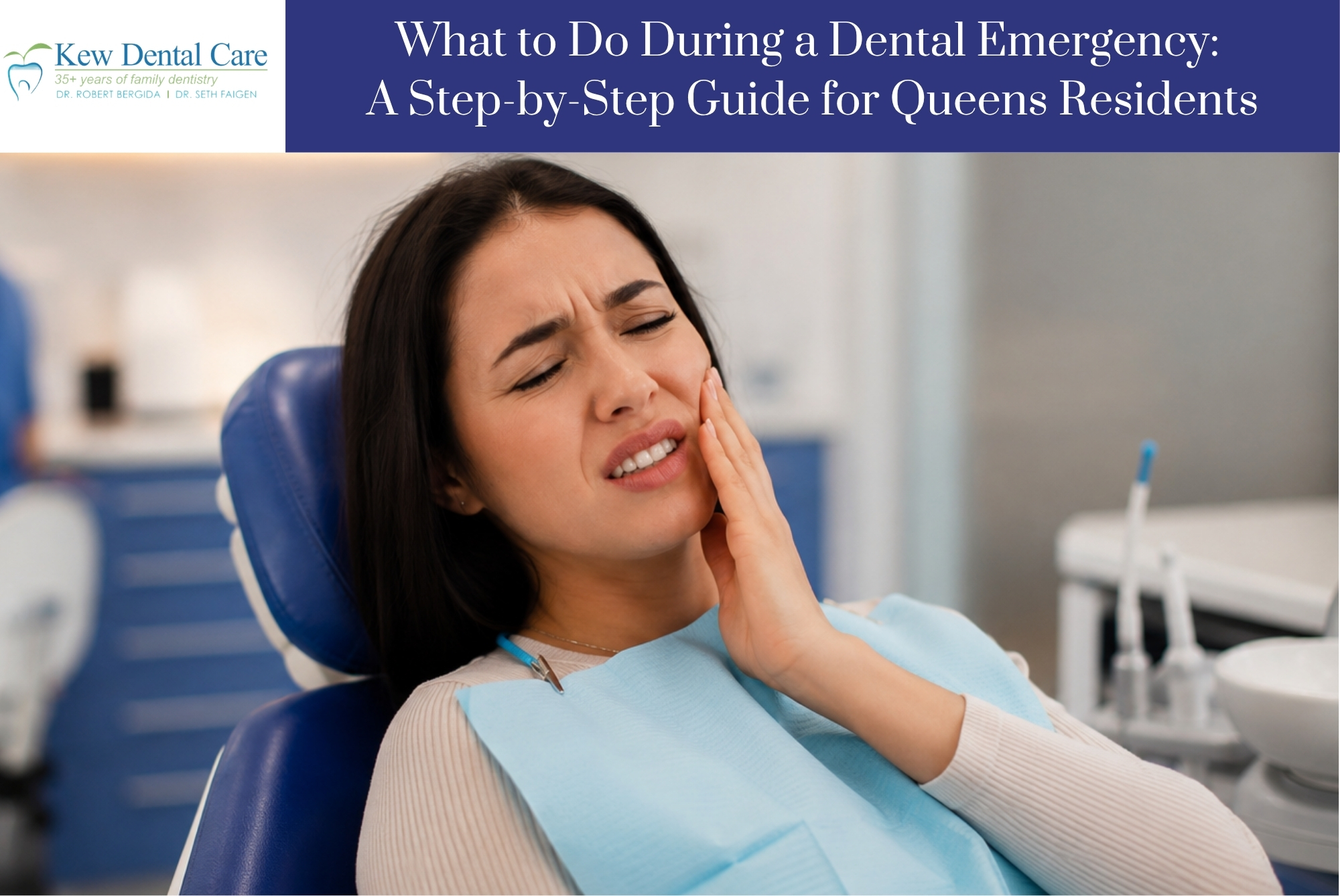
Dental emergencies can happen suddenly. A severe toothache may begin in the middle of the night, a tooth can break during a meal, or an accident can knock out a tooth without warning. When these situations occur, knowing what to do during the first few minutes can help protect your oral health, reduce discomfort, and potentially improve the chances of saving a damaged tooth.
For residents of Richmond Hill and surrounding Queens communities, having a plan before an emergency occurs can make an unexpected situation easier to manage. At Kew Dental Care, our dental team evaluates urgent dental problems and provides treatment based on the cause, severity, and condition of the affected teeth and surrounding tissues.
If you are searching for an emergency dentist in Richmond Hill, NY, understanding what qualifies as a dental emergency—and what you should do before reaching the dental office—is an important first step.
What Is Considered a Dental Emergency?
Understanding Urgent Dental Problems
A dental emergency generally involves significant pain, trauma, infection, uncontrolled bleeding, or another problem that could threaten a tooth or the surrounding oral tissues if treatment is delayed.
Some dental problems require prompt attention even when the discomfort initially seems manageable. Dental infections, for example, may progress beyond the tooth and affect nearby tissues.
Common situations that may require urgent dental care include:
- Severe or persistent tooth pain
- A knocked-out permanent tooth
- A partially dislodged or loosened permanent tooth
- A cracked, fractured, or severely broken tooth
- Dental swelling or a suspected abscess
- Facial swelling associated with a dental problem
- Significant bleeding from the mouth
- Trauma involving the teeth, gums, or jaw
- A lost filling or crown accompanied by pain or significant sensitivity
- An object lodged between teeth that cannot be safely removed
- Injury to dental restorations that causes pain or exposes the underlying tooth
When you are uncertain about the seriousness of a dental problem, contacting a dental office promptly can help determine the appropriate next step.
Step 1: Assess the Situation
Determine Whether Immediate Medical Attention Is Necessary
The first step during any dental emergency is to assess the person’s overall condition.
Some injuries extend beyond dentistry and require emergency medical attention. Call 911 or seek emergency medical care for potentially life-threatening symptoms such as difficulty breathing or swallowing, severe facial trauma, loss of consciousness, suspected jaw fracture, or bleeding that cannot be controlled.
Significant swelling involving the face or neck, particularly when accompanied by breathing or swallowing difficulties, can also require emergency medical evaluation.
Once immediate medical dangers have been ruled out, contact a dentist for guidance regarding the dental injury or symptoms.
Step 2: Contact an Emergency Dentist as Soon as Possible
Why Prompt Dental Evaluation Matters
When a dental emergency occurs, contact a dentist promptly and explain what happened. Provide information about your symptoms, when the problem started, whether an injury occurred, and whether there is swelling or bleeding.
Early evaluation may allow the dentist to diagnose the underlying problem before additional damage develops.
Residents looking for an emergency dentist in Richmond Hill, NY can contact Kew Dental Care at (718) 849-9472 for information regarding urgent dental concerns and appointment availability.
Step 3: Know What to Do for a Severe Toothache
Tooth Pain Should Not Be Ignored
A toothache is one of the most common reasons patients seek emergency dental treatment. Tooth pain can result from several conditions, including:
- Tooth decay
- Dental infection
- An abscess
- A cracked tooth
- An injured dental nerve
- Gum disease
- A damaged filling or crown
- Food or debris trapped between teeth
- Teeth grinding or trauma
Gently rinse your mouth with warm water and carefully floss around the affected tooth if you suspect food has become trapped.
Avoid placing aspirin directly against the tooth or gum tissue. Aspirin can irritate oral tissues and does not treat the underlying cause of tooth pain.
A dentist needs to determine why the tooth hurts before appropriate treatment can be recommended.
Step 4: Act Quickly if a Permanent Tooth Is Knocked Out
A Knocked-Out Tooth Is Time-Sensitive
A completely knocked-out permanent tooth is one of the most time-sensitive dental emergencies.
If a permanent tooth has been knocked out:
- Pick it up by the crown—the portion normally visible in the mouth—not by the root.
- If the tooth is dirty, gently rinse it briefly without scrubbing or scraping the root.
- Do not remove attached tissue fragments.
- If possible, gently reposition the tooth in its socket without forcing it.
- If reinsertion is not possible, keep the tooth moist. Depending on the circumstances, an appropriate tooth-preservation solution or milk may be used.
- Contact a dentist immediately and seek urgent dental treatment.
The chances of successfully managing an avulsed permanent tooth are generally better when professional care is obtained quickly.
A knocked-out baby tooth should not be replanted, because doing so could potentially damage the developing permanent tooth underneath it.
Step 5: Protect a Chipped, Cracked, or Broken Tooth
Save Any Pieces of the Tooth
A broken tooth can range from a small enamel chip to a fracture that reaches deeper structures within the tooth.
If possible, collect any pieces of the tooth and bring them to the dentist. Rinse the mouth gently with warm water.
If swelling develops following an injury, a cold compress placed against the outside of the face may help temporarily.
Even when a broken tooth does not hurt, it should be evaluated. Some fractures can expose or compromise deeper tooth structures without producing immediate severe pain.
Step 6: Take Swelling or a Suspected Dental Abscess Seriously
Dental Infections Can Spread
A dental abscess is an infection that may develop around the root of a tooth or within surrounding gum tissues. Possible symptoms include:
- Persistent or throbbing tooth pain
- Gum swelling
- Facial swelling
- Tenderness when biting
- Sensitivity to temperature
- A pimple-like bump on the gum
- An unpleasant taste or drainage in the mouth
- Fever or feeling unwell
Dental abscesses generally require professional treatment. The appropriate treatment depends on the source and extent of the infection and may involve addressing the infected tooth, draining an infection when clinically appropriate, or other dental treatment.
Antibiotics may be appropriate in certain circumstances, but they do not replace treatment of the underlying dental source.
Rapidly increasing swelling, difficulty breathing or swallowing, severe weakness, or other serious systemic symptoms warrant emergency medical attention.
Step 7: Manage a Lost Filling or Crown Carefully
Protect the Tooth Until Your Appointment
Fillings and crowns can become loose or fall out because of decay, wear, trauma, or changes to the underlying tooth.
If a crown comes off, keep it and bring it to your appointment. Avoid chewing on the affected side, particularly if the tooth is sensitive.
Do not use household adhesives or superglue to reattach a crown. These products are not intended for use inside the mouth and may complicate professional treatment.
A dentist can determine whether the restoration can be replaced or whether the tooth requires additional treatment.
Step 8: Respond Appropriately to Soft-Tissue Injuries
Cuts to the Lips, Cheeks, Tongue, and Gums
Injuries to the tongue, lips, cheeks, or gums can sometimes produce significant bleeding because oral tissues have a rich blood supply.
Gently rinse the mouth and apply clean gauze with steady pressure to the bleeding area when possible. A cold compress against the outside of the mouth may help with swelling.
If bleeding is severe, does not stop with sustained pressure, or accompanies significant facial trauma, seek emergency medical care.
Step 9: Do Not Force an Object Stuck Between the Teeth
Avoid Sharp Objects
Food or another object trapped between teeth can cause significant discomfort.
Try gently using dental floss to remove it. Avoid using needles, pins, knives, or other sharp objects, as these can injure the gums or damage tooth enamel.
If the object cannot be safely removed, contact a dentist.
Step 10: Know What Not to Do During a Dental Emergency
Common Mistakes Can Make the Problem Worse
During a dental emergency, avoid actions that could create additional damage.
Do not place aspirin directly on gum tissue. Do not apply household glue to dental restorations. Do not scrub the root of a knocked-out tooth. Do not attempt to drain an abscess yourself. Do not use sharp instruments to remove objects between teeth.
Most importantly, do not assume that the disappearance of pain means the underlying dental problem has resolved. In some cases, symptoms may temporarily decrease even though disease or damage remains.
Why Dental Emergencies Need Professional Diagnosis
Treating the Cause Rather Than Only the Symptoms
Pain is a symptom, not a diagnosis. Two people with similar toothaches may have entirely different dental conditions.
A dentist may use a clinical examination and, when appropriate, dental imaging to determine whether symptoms are associated with decay, infection, fracture, periodontal disease, trauma, or another condition.
The goal of emergency dental care is not simply to reduce discomfort. It is to identify the source of the problem, stabilize the condition, preserve oral health whenever possible, and establish an appropriate treatment plan.
Emergency Dental Care in Richmond Hill, Queens
Convenient Dental Care for Local Residents
When an urgent dental problem occurs, proximity to professional care can be important. Kew Dental Care is located at 116-14 Metropolitan Ave in Richmond Hill, NY, serving patients in Richmond Hill and surrounding Queens communities.
Patients searching online for an emergency dentist in Richmond Hill, NY may be experiencing significant discomfort or uncertainty about what to do next. Calling the dental office promptly allows the team to learn more about the situation and provide guidance regarding appropriate care and appointment availability.
Preparing for a Dental Emergency Before One Happens
A Simple Dental Emergency Plan
Emergencies are easier to manage when you already know whom to contact.
Save your dentist’s phone number in your mobile phone and keep basic first-aid supplies such as clean gauze and a cold pack readily available.
If you participate in contact sports or activities with a risk of facial injury, ask your dentist about an appropriately fitted mouthguard. Preventing dental trauma is preferable to treating it after an accident occurs.
Regular dental examinations can also help identify decay, failing restorations, gum disease, and other problems before they progress into urgent situations.
Frequently Asked Questions About Dental Emergencies
What is the most common dental emergency?
Severe tooth pain is among the most common urgent dental complaints. Causes can include decay, infection, cracked teeth, damaged restorations, gum problems, or trauma. Because the underlying cause cannot always be identified from symptoms alone, persistent or severe tooth pain should be professionally evaluated.
How do I know if my toothache is an emergency?
Severe or persistent pain, swelling, fever, trauma, difficulty biting, drainage, or rapidly worsening symptoms are reasons to contact a dentist promptly. Difficulty breathing or swallowing or significant facial or neck swelling requires emergency medical attention.
Can an emergency dentist save a knocked-out tooth?
Sometimes. A permanent tooth that has been completely knocked out may be successfully replanted under appropriate circumstances, but time and proper handling are important. Contact a dentist immediately.
Should I go to the emergency room for a dental emergency?
Hospital emergency care is appropriate when a dental or facial problem involves potentially life-threatening symptoms, uncontrolled bleeding, severe trauma, breathing or swallowing difficulties, or other serious medical concerns. Many tooth-specific problems ultimately require treatment by a dentist.
Is a broken tooth considered a dental emergency?
It can be. A deep fracture, significant pain, bleeding, trauma, or exposure of internal tooth structures may require urgent treatment. Even a painless fracture should be evaluated because the extent of damage may not be visible.
Is facial swelling from a tooth an emergency?
Facial swelling associated with dental pain or infection should be evaluated promptly. Rapidly increasing swelling, swelling extending toward the neck or eye, or difficulty breathing or swallowing warrants immediate medical attention.
What should I do if my crown falls out?
Keep the crown, avoid chewing on the affected tooth, and contact your dentist. Do not use superglue or household adhesives to replace it.
What should I do if a filling falls out?
Contact your dentist for evaluation and avoid chewing hard foods on the affected side. A lost filling may expose underlying tooth structure and can cause sensitivity or allow further damage.
Can a dental abscess go away without treatment?
Symptoms may fluctuate, but an abscess or its underlying cause generally requires professional dental evaluation and treatment. A decrease in pain should not automatically be interpreted as resolution of the infection.
Should I take antibiotics for a tooth infection?
Antibiotics are appropriate for certain dental infections but are not necessary or sufficient for every toothache. A dentist or other qualified healthcare professional should determine whether antibiotics are indicated. Definitive dental treatment may still be necessary to address the source of infection.
What should I do if my child’s permanent tooth is knocked out?
Handle the tooth by the crown rather than the root, keep it moist, and seek dental care immediately. If you are unsure whether the tooth is permanent or primary, contact a dentist for immediate guidance rather than attempting to reinsert it.
Can I wait until tomorrow if my tooth stops hurting?
The disappearance of pain does not necessarily mean that the underlying problem has resolved. Dental pulp damage or infection can sometimes progress even when symptoms change. Contact your dentist and describe what happened so they can advise you about the appropriate timing of an examination.
How quickly should I see an emergency dentist?
The appropriate timing depends on the problem. A knocked-out permanent tooth requires immediate attention, while severe pain, swelling, infection, significant fractures, and traumatic injuries generally warrant prompt assessment. When uncertain, call the dental office and explain your symptoms.
How can I find an emergency dentist in Richmond Hill, NY?
If you live in Richmond Hill or the surrounding Queens area and experience an urgent dental problem, contact Kew Dental Care at (718) 849-9472. Explain your symptoms and when they began so the office can provide information about appropriate next steps and appointment availability.
Protect Your Smile When a Dental Emergency Happens
Dental emergencies are stressful, but an informed response can make a meaningful difference. Stay calm, assess whether there are any serious medical symptoms, protect the injured tooth or oral tissues, and contact a dentist promptly.
For Queens residents seeking an emergency dentist in Richmond Hill, NY, Kew Dental Care provides a local resource for evaluating urgent dental concerns. Whether you are experiencing severe tooth pain, a damaged restoration, swelling, or dental trauma, professional diagnosis is essential for determining the appropriate treatment.
Knowing what to do before an emergency happens can help you respond more confidently when every minute matters.
Contact Information
Kew Dental Care
116-14 Metropolitan Ave
Richmond Hill, NY 11418
Phone: (718) 849-9472
Website: kewdentalcare.com
Appointments: kewdentalcare.com/appointments/