
Missing a tooth can affect much more than the appearance of your smile. A gap left by a lost tooth may influence how you chew, how clearly you speak, the alignment of neighboring teeth, and the health of the underlying jawbone. Fortunately, modern restorative dentistry offers several effective ways to replace missing teeth.
Two of the most common solutions are dental implants and dental bridges. Both can restore function and improve the appearance of your smile, but they accomplish these goals in very different ways.
At Kew Dental Care in Richmond Hill, NY, patients considering tooth replacement can receive an individualized evaluation to determine which approach best fits their oral health, anatomy, lifestyle, and long-term dental needs. If you are researching dental implants in Richmond Hill, understanding how implants compare with traditional bridges is an important first step.
Why Replacing a Missing Tooth Is Important
Losing a permanent tooth can create changes throughout the mouth. Teeth function together as part of an interconnected system, so the absence of even one tooth may affect surrounding structures.
Changes in Tooth Alignment
When a tooth is missing, adjacent teeth may gradually shift or tilt toward the open space. Opposing teeth can also move because they no longer have a tooth making contact with them during biting.
These changes can alter the bite and potentially make certain areas more difficult to clean.
Changes in Chewing Function
Depending on the location of the missing tooth, patients may begin chewing predominantly on the opposite side of their mouth. Restoring the missing tooth can help distribute chewing forces more evenly.
Jawbone Changes
Natural tooth roots transmit forces into the jawbone during biting and chewing. When a tooth is lost, the bone in that area no longer receives the same stimulation and can gradually decrease in volume.
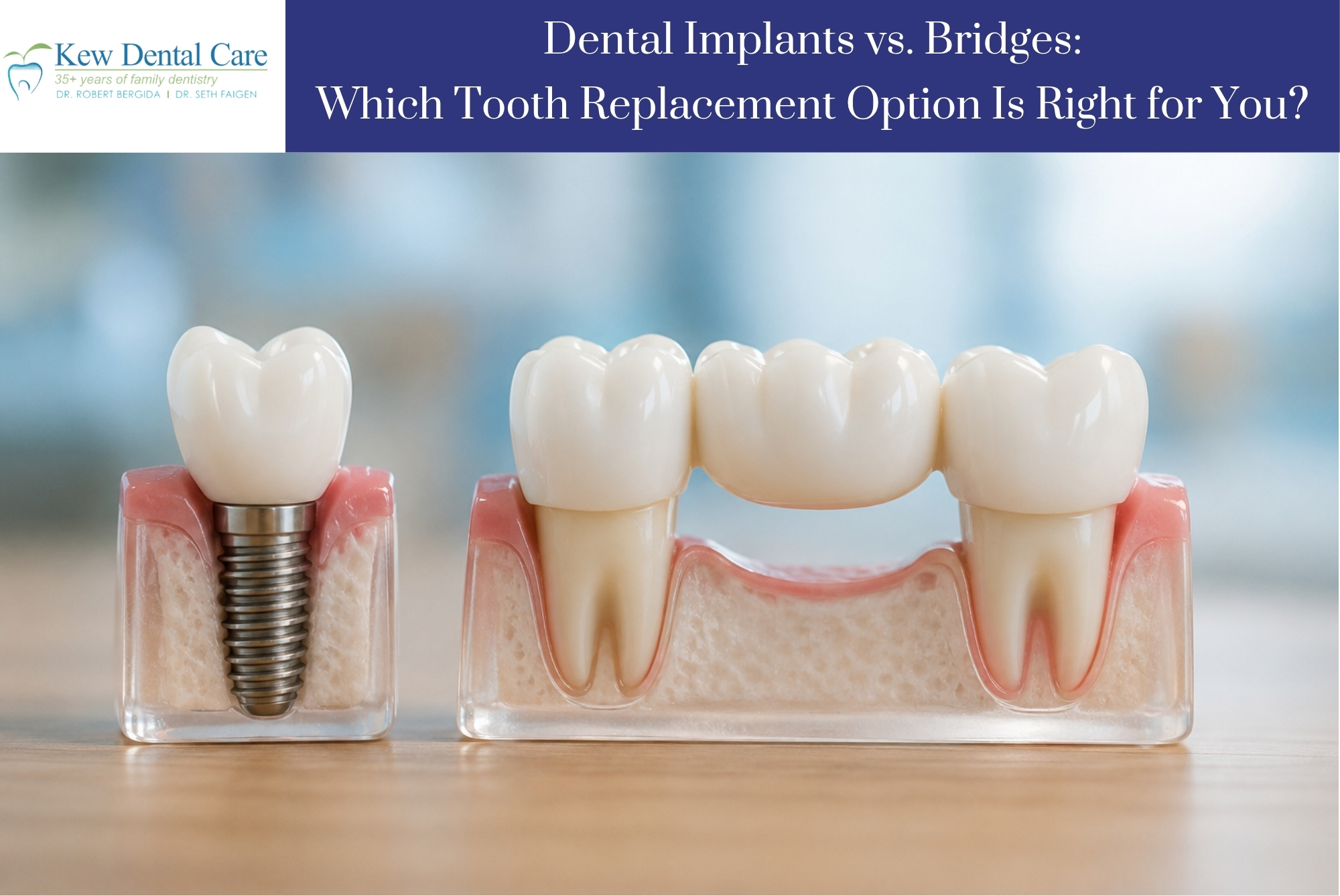
This is one of the significant differences between dental implants and conventional bridges: an implant is placed within the jawbone, while a traditional bridge replaces the visible portion of the missing tooth without replacing its root.
Appearance and Confidence
Missing teeth, particularly in visible areas of the smile, can affect a person’s confidence. Both dental implants and bridges can be designed to resemble natural teeth and restore a more complete smile.
What Is a Dental Implant?
A dental implant is a tooth replacement system designed to replace both the visible tooth and its supporting root structure.
The Three Main Components of a Dental Implant
A typical implant restoration consists of three components:
Dental implant: A biocompatible post, commonly made from titanium, that is surgically positioned within the jawbone.
Abutment: A connector placed between the implant and the final restoration.
Dental crown: The visible artificial tooth attached to the implant.
After placement, the implant undergoes a biological healing process known as osseointegration, during which the surrounding bone forms a stable connection with the implant surface.
Why Dental Implants Are Different From Other Tooth Replacements
Because an implant is anchored directly within the jaw, it functions independently of neighboring teeth. Unlike a conventional dental bridge, a single-tooth implant generally does not require adjacent healthy teeth to be reshaped to support the restoration.
What Is a Dental Bridge?
A dental bridge is a fixed restoration designed to “bridge” the space created by one or more missing teeth.
How a Traditional Dental Bridge Works
A traditional bridge generally uses teeth on either side of the missing tooth as supports. These supporting teeth, called abutment teeth, are prepared for crowns.
An artificial tooth, known as a pontic, fills the space between them. The crowns and pontic are connected to form one restoration that is permanently cemented into place.
Can Bridges Replace More Than One Tooth?
Yes. Depending on the location of the missing teeth, condition of the supporting teeth, bite forces, and other clinical considerations, a bridge may replace multiple adjacent teeth.
Not every missing-tooth situation is suitable for a conventional bridge, which is why a comprehensive dental examination is important.
Dental Implants vs. Bridges: Understanding the Major Differences
Both options can successfully replace missing teeth, but several important differences can influence which treatment is more appropriate.
Effect on Neighboring Teeth
One of the principal advantages of a single dental implant is that it can replace a tooth independently.
A conventional bridge usually requires preparation of the neighboring teeth so crowns can be placed over them.
If those neighboring teeth already have large fillings, crowns, or significant structural damage, incorporating them into a bridge may sometimes be clinically reasonable. When neighboring teeth are healthy and largely intact, preserving their natural structure may make an implant particularly attractive.
Jawbone Preservation
Dental implants transfer chewing forces into the jawbone. This functional stimulation can help maintain bone around the implant.
A conventional bridge sits above the gum tissue and does not replace the missing tooth root. Therefore, it does not provide the same type of direct bone stimulation.
Treatment Time
Bridges can often be completed more quickly than dental implants because implant treatment involves surgical placement and healing.
Dental implant treatment may require several months from initial placement to final restoration, although the exact timeline varies considerably.
Factors affecting treatment time can include:
- Bone quantity and quality
- Number and location of implants
- Need for bone grafting
- Healing response
- Gum health
- Overall oral health
- Type of final restoration
Surgery
Dental implant placement is a surgical procedure. Patients must therefore be evaluated to determine whether implant surgery is appropriate.
A conventional bridge does not require placement of an implant into the jawbone, although the supporting teeth must be prepared.
Cleaning and Maintenance
Both options require excellent oral hygiene.
A single dental implant can generally be brushed similarly to a natural tooth, while cleaning around the implant and gumline remains essential.
Because a traditional bridge connects multiple teeth together, floss cannot simply pass vertically between the connected crowns. Patients typically need floss threaders, interdental brushes, water flossers, or other recommended cleaning aids to clean underneath the pontic.
Longevity
Dental implants are designed as long-term tooth replacements, but no dental treatment should be considered indestructible or guaranteed for life. Implant success depends on appropriate case selection, surgical and restorative factors, oral hygiene, maintenance, bite forces, and general health.
Dental bridges can also provide many years of service when properly designed and maintained. However, decay or structural problems affecting one of the supporting teeth may compromise the entire bridge.
Advantages of Dental Implants
For appropriately selected patients, dental implants offer several important benefits.
Independent Tooth Replacement
An implant-supported crown replaces a missing tooth without relying on adjacent teeth for support.
Natural Appearance
Modern implant crowns can be carefully designed to coordinate with the shape, proportions, and shade of surrounding teeth.
Strong Chewing Function
Because an implant is anchored within the jawbone, it can provide stable support for the restoration and help restore effective chewing.
Bone Support
Implants transmit functional forces into the surrounding jawbone, which can help maintain bone in the area of the missing tooth.
Versatility
Dental implants are not limited to replacing one tooth. Depending on the patient’s needs, implants can support:
- Individual crowns
- Implant-supported bridges
- Partial-arch restorations
- Full-arch restorations
- Certain implant-supported or implant-retained dentures
Potential Considerations With Dental Implants
Although implants offer important advantages, they are not automatically the right treatment for every patient.
Adequate Bone Is Important
Dental implants need sufficient bone for support. If bone has been lost following tooth loss, periodontal disease, infection, trauma, or other causes, additional procedures such as bone grafting may sometimes be recommended.
Healing Takes Time
The implant needs time to integrate with the surrounding bone. Patients should understand that implant dentistry may involve multiple stages.
Oral Hygiene Remains Essential
Dental implants cannot develop cavities, but the tissues surrounding an implant can become inflamed or diseased.
Peri-implant mucositis is inflammation of the soft tissue surrounding an implant. If disease progresses and supporting bone is lost, the condition is known as peri-implantitis.
Consistent brushing, interdental cleaning, professional examinations, and dental cleanings remain important after implant treatment.
Advantages of Dental Bridges
Traditional bridges remain a valuable restorative option and may be particularly appropriate in certain clinical situations.
No Implant Surgery
A conventional bridge may appeal to patients who cannot undergo implant placement or who prefer a nonsurgical tooth replacement approach.
Potentially Shorter Treatment Process
Because there is no need to wait for an implant to integrate with the jawbone, treatment can often be completed more quickly.
Useful When Neighboring Teeth Need Crowns
If teeth adjacent to a missing tooth already require crowns because of extensive restorations, fractures, or other structural concerns, a bridge may address multiple restorative needs simultaneously.
Potential Considerations With Dental Bridges
Patients should also understand the limitations associated with bridges.
Preparation of Supporting Teeth
Traditional bridges generally require removing some tooth structure from the supporting teeth to accommodate crowns.
Supporting Teeth Carry Additional Responsibility
The bridge depends on the health and strength of the abutment teeth. Cavities, fractures, gum disease, or other problems involving these teeth can affect the restoration.
Specialized Cleaning Is Required
Food debris and plaque can accumulate beneath the artificial tooth. Daily cleaning under the bridge is therefore important.
A Bridge Does Not Replace the Tooth Root
Because a traditional bridge does not extend into the jawbone, it does not provide the same bone stimulation as a dental implant.
Who May Be a Good Candidate for Dental Implants?
Many adults who have lost one or more teeth may potentially qualify for implant treatment, but candidacy should always be determined through a professional examination.
Healthy Gums
Active periodontal disease should generally be addressed as part of preparing the mouth for long-term restorative treatment.
Sufficient Jawbone
The dentist will evaluate whether enough bone is available to support an implant. When necessary, bone augmentation may be considered.
Good Oral Hygiene
Successful implant treatment requires a commitment to brushing, interdental cleaning, professional maintenance, and periodic examinations.
Appropriate Overall Health
A patient’s medical history, medications, smoking or tobacco use, and other health-related factors may influence healing and implant treatment planning.
Patients should provide their dentist with a complete and accurate medical history before treatment.
Who May Be a Good Candidate for a Dental Bridge?
A bridge may be considered when the teeth surrounding the missing area are sufficiently strong to support the restoration.
It may also be appropriate when implant placement is not recommended, when a patient prefers to avoid implant surgery, or when the neighboring teeth already need significant restorative treatment.
The condition of the supporting teeth, gums, bone, bite, and remaining dentition should all be considered.
What Happens During a Dental Implant Evaluation?
Patients searching for dental implants in Richmond Hill should expect treatment planning to begin with a detailed evaluation rather than immediately choosing a restoration.
Comprehensive Dental Examination
The dentist evaluates the missing-tooth area along with the health of surrounding teeth and gums.
Dental Imaging
Dental X-rays and, when clinically appropriate, three-dimensional imaging can provide important information about bone anatomy and nearby structures.
Periodontal Evaluation
Healthy gums and supporting tissues are important for long-term implant health.
Bite Assessment
The forces generated during biting and chewing can influence implant position and restoration design.
Patients who grind or clench their teeth may require additional treatment planning considerations.
Personalized Treatment Planning
The dentist can then discuss whether an implant, bridge, or another restorative approach best addresses the patient’s individual circumstances.
What Does the Dental Implant Process Involve?
The exact process varies, but treatment generally follows several stages.
Initial Planning
The dentist evaluates the mouth, reviews diagnostic imaging, discusses the patient’s medical and dental history, and develops a treatment plan.
Implant Placement
The implant is surgically positioned within the jawbone.
Healing and Osseointegration
The surrounding bone heals around the implant and establishes a stable biological connection.
Restorative Phase
After sufficient healing, an abutment and custom restoration are placed to complete the tooth replacement.
Some cases may follow different protocols, so patients should rely on their individual treatment plan rather than a universal timeline.
What Does the Dental Bridge Process Involve?
A conventional bridge generally requires preparing the supporting teeth and creating a precise restoration.
Preparing the Abutment Teeth
The teeth adjacent to the missing space are shaped so they can receive crowns.
Impressions or Digital Scans
Detailed records are obtained to help create a bridge that fits the prepared teeth and coordinates with the patient’s bite.
Temporary Restoration
Depending on the treatment process, a temporary bridge may protect the prepared teeth while the definitive restoration is being fabricated.
Final Bridge Placement
The completed bridge is evaluated for fit, bite, appearance, and function before being permanently cemented.
Dental Implants vs. Bridges: Which Looks More Natural?
Both implants and bridges can provide excellent cosmetic results when carefully planned.
For a single missing tooth, an implant-supported crown can often closely replicate the appearance of an independent natural tooth. A bridge can also provide an attractive result, particularly when the supporting teeth need crowns for other reasons.
The final appearance depends on numerous factors, including:
- Gum contours
- Bone volume
- Tooth position
- Restoration materials
- Tooth shade
- Smile line
- Condition of neighboring teeth
- Location of the missing tooth
Cosmetic outcome should therefore be evaluated as part of comprehensive treatment planning.
Which Option Is Better for Long-Term Oral Health?
There is no single answer that applies to every patient.
For someone with healthy neighboring teeth, adequate bone, healthy gums, and appropriate overall health, an implant may offer significant advantages because it independently replaces the missing tooth and does not require preparation of adjacent teeth.
For another patient, a bridge may be more appropriate because of the condition of the neighboring teeth, anatomy, medical considerations, personal preference, or restorative needs.
The best option is the one that provides a predictable restoration while preserving as much long-term oral health as possible for that individual patient.
Caring for Dental Implants
Implants require lifelong maintenance just as natural teeth do.
Patients should:
- Brush thoroughly at least twice daily
- Clean between teeth and around the implant
- Use interdental aids recommended by their dental team
- Attend regular professional cleanings
- Receive periodic dental examinations
- Avoid tobacco products
- Discuss persistent bleeding, swelling, discomfort, or mobility with a dentist
Professional monitoring allows the dentist to evaluate both the restoration and the tissues supporting the implant.
Caring for a Dental Bridge
A bridge also requires careful daily maintenance.
Patients should brush the bridge and surrounding teeth thoroughly and clean underneath the pontic every day.
Depending on the design, the dental team may recommend specialized floss, floss threaders, interdental brushes, or a water flosser.
Keeping the supporting teeth healthy is particularly important because the bridge depends on them for stability.
Why Professional Evaluation Matters
Choosing between an implant and a bridge should not be based solely on convenience or appearance.
The dentist must consider the health of the entire oral system, including the teeth, gums, jawbone, bite, and supporting structures.
A comprehensive evaluation at Kew Dental Care can help patients understand their available options and the advantages and limitations associated with each approach.
For patients researching dental implants in Richmond Hill, NY, a personalized consultation is the most reliable way to determine whether implant dentistry, a dental bridge, or another restorative solution is appropriate.
Frequently Asked Questions About Dental Implants and Bridges
Are dental implants better than bridges?
Not necessarily for every patient. Dental implants offer advantages such as independent tooth replacement, preservation of adjacent tooth structure, and stimulation of the surrounding jawbone. Bridges can be excellent solutions when neighboring teeth need crowns, implant surgery is not appropriate, or a patient prefers a different treatment approach.
How long do dental implants last?
Dental implants are intended to provide long-term support, and many remain functional for many years with appropriate care. Longevity depends on oral hygiene, gum and bone health, bite forces, tobacco use, general health, professional maintenance, and other individual factors. The crown attached to an implant may eventually require replacement even when the implant itself remains healthy.
How long does a dental bridge last?
A well-designed and properly maintained bridge can provide many years of service. Its lifespan depends heavily on the health of the supporting teeth, oral hygiene, bite forces, restoration materials, and professional maintenance.
Does getting a dental implant hurt?
Implant placement is generally performed with appropriate local anesthesia, and additional comfort options may be available depending on the clinical situation. Some temporary tenderness, swelling, or discomfort can occur during healing. Your dentist can provide individualized information about what to expect.
Can I get an implant immediately after a tooth extraction?
Immediate implant placement is possible in selected cases, but it is not appropriate for everyone. Bone anatomy, infection, gum tissue, implant stability, and the location of the tooth all influence the decision.
What happens if I do not have enough bone for an implant?
Bone grafting or other augmentation procedures may sometimes be used to create adequate support for an implant. Whether this is necessary can only be determined after examining the area and reviewing appropriate imaging.
Can dental implants get cavities?
The implant and implant crown cannot develop tooth decay because they are not natural tooth structures. However, natural teeth around the implant can still develop cavities, and the gum and bone surrounding an implant can develop inflammatory disease.
Can a bridge get cavities?
The artificial portion of a bridge cannot develop a cavity, but the natural supporting teeth underneath the crowns can develop decay, particularly around restoration margins. Good oral hygiene and professional dental care are therefore essential.
Is a dental implant removable?
A conventional implant-supported crown is designed as a fixed restoration and is not removed by the patient. Other types of implant-supported restorations, such as certain implant-retained dentures, may be removable.
Do bridges feel like natural teeth?
A properly designed bridge can feel stable and comfortable and can restore significant chewing function. Because the teeth are connected, however, cleaning and flossing around a bridge differs from cleaning individual natural teeth.
Can dental implants replace several missing teeth?
Yes. Multiple missing teeth do not necessarily require one implant for every tooth. In some situations, strategically positioned implants can support an implant-supported bridge. Treatment depends on bone availability, tooth position, bite forces, and other clinical considerations.
Can I replace all of my teeth with dental implants?
Implants can be used as part of full-arch tooth replacement. Several approaches are available, including fixed implant-supported restorations and implant-retained removable prostheses. A comprehensive evaluation is necessary to determine the appropriate design.
Are dental implants safe?
Dental implant therapy is a well-established treatment in modern dentistry. As with any surgical procedure, however, it carries potential risks and requires appropriate diagnosis, treatment planning, surgical technique, healing, and follow-up care.
What if I grind my teeth?
Teeth grinding and clenching can place substantial forces on natural teeth and dental restorations. Patients with bruxism should tell their dentist. Bite management and, in some cases, a protective nightguard may be recommended.
Is an implant or bridge easier to clean?
A single implant crown often allows cleaning between neighboring teeth in a manner more similar to natural teeth. A traditional bridge requires cleaning underneath the connected artificial tooth using specialized techniques or tools.
How soon after losing a tooth should I discuss replacement?
It is generally beneficial to discuss tooth replacement relatively soon after tooth loss. Bone and gum tissue can change over time, and neighboring teeth may begin shifting. Early evaluation does not necessarily mean immediate treatment, but it can help preserve future treatment options.
How do I know which option is right for me?
The most appropriate solution depends on factors such as the location and number of missing teeth, health of neighboring teeth, gum health, available bone, bite, medical history, treatment goals, and personal preferences.
A dental examination and appropriate diagnostic imaging are the best ways to determine whether an implant, bridge, or alternative restoration is recommended.
Restore Your Smile With Kew Dental Care
Missing teeth do not have to permanently affect your ability to smile, speak, and chew comfortably. Dental implants and bridges both offer established approaches for restoring missing teeth, but their design, treatment process, maintenance requirements, and effects on surrounding oral structures differ.
If you are considering dental implants in Richmond Hill, the team at Kew Dental Care can evaluate your oral health and discuss the tooth replacement options that may be appropriate for your individual needs.
A personalized treatment plan can help you make an informed decision based on your dental health today as well as your long-term restorative goals.
Contact Information
Kew Dental Care
116-14 Metropolitan Ave
Richmond Hill, NY 11418
Phone: (718) 849-9472
Website: kewdentalcare.com
Appointments: kewdentalcare.com/appointments/